












Published on May 22, 2026 11:16 am
Last Updated on May 22, 2026 11:16 am
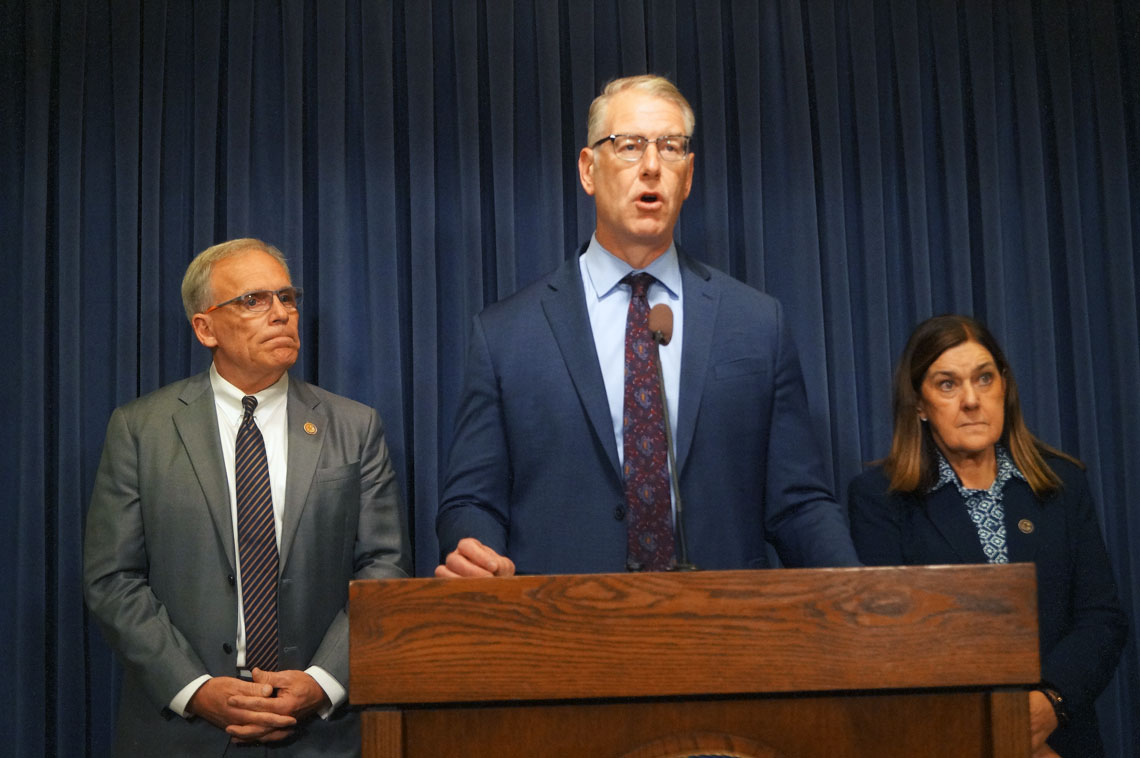

Senate Republican Leader John Curran is flanked by fellow Republicans Sen. Dave Syverson and Sen. Jil Tracy as he calls on the governor to opt into a federal school choice program. (Capitol News Illinois photo by Peter Hancock)
Pressure arrives as Democratic New York governor says she’ll opt into federal tax credit
By MARISA GUERRA ECHEVERRIA
Medill Illinois News Bureau
Article Summary
- Senate Republicans are calling on their colleagues and the governor to opt into a federal school choice tax credit program.
- Nationally, 31 states have done so, with two Democratic governor signaling their intent to opt in.
- Gov. JB Pritzker has taken a cautious approach in the absence of specific federal guidelines for the program.
This summary was written by the reporters and editors who worked on this story.
SPRINGFIELD – Senate Republicans on Wednesday called on their colleagues and Gov. JB Pritzker to opt Illinois into the Trump-backed Education Freedom Tax Credit.
The tax credit, passed under the One Big Beautiful Bill Act in 2025, is a dollar-for-dollar, nonrefundable tax credit for donations of up to $1,700 to designated scholarship-granting organizations. According to a January 2026 fact sheet published by the U.S. departments of Education and Treasury, scholarships may be used to supplement expenses for private, public and charter schools.
The demand follows a renewed wave of pressure for either Pritzker or the General Assembly to opt the state into the federal tax credit after New York recently became one of the latest states and the second Democratic-led state signaling its intent to do so.
Senate Republican Leader John Curran, R-Downers Grove, said “time is of the essence” to opt into the program ahead of its Jan. 1, 2027 deadline.
While any taxpayer throughout the country can take advantage of the tax credit, only students in states opted into the program can benefit from scholarships. According to Curran, delaying the decision means hindering the formation of scholarship granting organizations and losing willing taxpayers in Illinois, which would disadvantage the state in the competition for “free federal dollars.
“They are going to go to other states if Illinois does not opt in,” Curran said. “We will be left out and left behind.”
Read more: School choice option at standstill as legislators weigh benefits, political fallout
Pritzker’s hesitance
The thorniness of the issue for Pritzker and several lawmakers comes from the fact that the IRS and the Treasury Department have yet to release specific federal guidelines for the program, which are expected in July.
In a statement on May 8, a spokesperson for the governor’s office said he’s reviewing the federal tax credit.
“We will evaluate the issue through a lens focused on affordability for working families and what best supports Illinois students, families, and public schools,” the spokesperson wrote in an email to CNI.
While New York Gov. Kathy Hochul’s spokesperson told Education Week earlier this month she “is supportive of the federal tax credit scholarship and its potential to help New York students and schools,” she also expressed similar caution.
“Our office awaits information from the federal government on the program and will thoroughly review the details of the policy for poison pills that could harm New York’s education system,” according to the statement.
Sen. Jil Tracy, R-Quincy, argued the tax credit could unlock an estimated $1 billion to fund education in Illinois, calling the decision a “no-brainer.” Curran said the tax credits can be used to fund a diverse array of education expenses for both public and private schools, such as commuter costs, after-school programs and support programs for children with developmental disabilities.
“This is a lifeline to those programs and families that are unable to afford those services,” Curran said.
Beyond making reference to Polis and Hochul, Curran highlighted the bipartisan Senate Bill 3776 to opt into the tax credit, led by Sen. Adriane Johnson, D-Buffalo Grove. Curransigned onto that bill on Monday, and argued at the news conference that school choice is a “bipartisan concept.”
Both Johnson’s bill and Curran’s Senate Bill 3850 to opt into the tax credit saw a flurry of new Republican co-sponsors this week.
Sen. Dave Syverson, R-Cherry Valley, noted that those who support public schools often also choose alternative education for their own families. The argument to opt into the tax credit, he added, comes from the shared sentiment that all Illinoisans want the best for their children.
“It just gives families, most of those low-income, the same educational choices and options that educators get, that legislators get, that the governor gets, that we should believe they should get as well,” Syverson said.
Scholarships funded through the tax credits are available to students from families with incomes up to 300% of their area’s median income.
Skepticism of the bill
While Curran acknowledged that federal guidance has been limited and that philanthropic programs are ultimately the ones that determine their funding endeavors, he argued that it has not stopped 31 governors from opting in or signaling to in-state donors that they will.
Skeptics of the bill, among them public school educators, school boards and activists, also have questioned the extent it will benefit public school students, fearing it will favor private schools and lead to disenrollment and defunding in the public school system.
Tracy said the federal program may benefit private school families who have suffered since the end of Illinois’ former school choice tax credit in 2023, the Illinois Invest in Kids Act. Curran mentioned that overall private school enrollment has also declined since then.
He maintains that the tax credit would not require any state funds or involvement beyond qualifying scholarship granting organizations from year to year, posing no downside to public schools.
“There’s not a family that would qualify on the income threshold, public or private, that would not have some use or some need to be a participant in this program,” Curran said.
Marisa Guerra Echeverria an undergraduate student in journalism and political science with Northwestern University’s Medill School of Journalism, Media, Integrated Marketing Communications, and a fellow in its Medill Illinois News Bureau working in partnership with Capitol News Illinois.
Capitol News Illinois is a nonprofit, nonpartisan news service that distributes state government coverage to hundreds of news outlets statewide. It is funded primarily by the Illinois Press Foundation and the Robert R. McCormick Foundation.


