












Published on April 21, 2026 2:50 pm
Last Updated on April 21, 2026 2:50 pm

Tax on millionaires garnering interest but showing little sign of progress
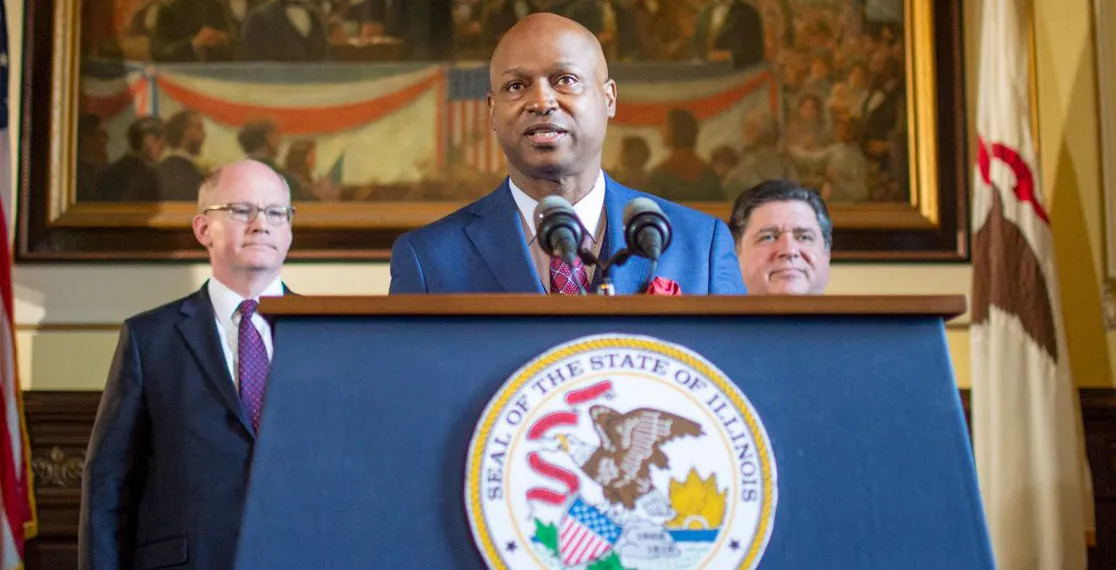
House Speaker Chris Welch is flanked by Senate President Don Harmon and Governor J.B. Pritzker at the State Capitol in 2023 (Capitol News Illinois photo by Jerry Nowicki)

The biggest item on Illinois lawmakers’ agenda this spring is still a work in progress with six weeks left in the legislative session.
Democrats are entering the home stretch of budget negotiations ahead of their scheduled May 31 adjournment while monitoring better-than-expected revenue growth alongside the uncertainty that is a hallmark of governing during Donald Trump’s presidency.
Revenue in the current fiscal year 2026 was up $1.5 billion through March compared to the same point last year, outpacing initial estimates, according to the Commission on Government Forecasting and Accountability’s March update.
Gov. JB Pritzker in February proposed increasing spending by just 0.5% outside of required areas like education and pensions for the upcoming budget year that begins July 1.
While the strong revenue performance thus far could give lawmakers greater flexibility in crafting the roughly $56 billion upcoming fiscal year 2027 budget, the upcoming April report will likely tell a fuller story. That report, set to be released in early May, has the capacity to make or break a budget due to its proximity to tax filing season.
“Right now, it’s all about information gathering, and (April 15) was Tax Day,” House Speaker Emanuel “Chris” Welch, D-Hillside, told reporters after a recent event in Springfield. “The reason a lot of things don’t happen until later is because we need to know the tax receipts. That’s going to be the final way to let you develop a number.”
While top leaders are entering May with caution, other rank-and-file Democrats are urging legislative leaders to aggressively raise taxes on high-income earners and businesses.
Evaluating next steps
Deputy Gov. Andy Manar, who leads budgeting in Pritzker’s office, told a Senate appropriations committee last week the governor’s office is planning to increase their FY26 revenue estimate in the coming weeks.
“We’re not surprised that the revenue is coming in higher than what we anticipated or the governor put into his budget for FY27 … we see it as good budgeting,” Manar said. “At the same time, we’re holding the line on spending, and at the same time, we still have these huge variables that are coming from Washington.”
But that number isn’t yet final, given the pending April numbers. And whether excess revenue is used for supplemental FY26 spending or as cushion for the upcoming fiscal year 2027 also isn’t clear.
Welch said he’s exercising caution for now.
“Thankfully, based on COGFA reports that we’ve seen, that the revenues have been coming in well,” Welch said. “But there’s still no way to backfill the holes that have been created by Trump, but we’re going to do the best we can with what we got.”
Even with the revenue growth, Manar said he doesn’t see the governor rescinding his proposed revenue changes, including a $200 million tax on social media companies, because there’s still a lot of uncertainty over the economy and federal funding.
The FY26 budget also included a provision that raised higher education spending by 1% for the year and held back an additional 2% in funding that could be released if Pritzker felt there was enough flexibility to spend the money. Sen. Chapin Rose, R-Mahomet, said the current revenue track means Pritzker should release the $29 million.
“Certainly because of what we have seen in terms of revenue growth because the state’s economy is growing, we should revisit that,” Manar said in response to questioning from Rose. “We certainly should, but that’s going to be in conjunction with the General Assembly.”
Senate President Don Harmon, D-Oak Park, was also cautious.
“I’m grateful that this year’s path to a responsible, balanced budget looks a little easier than it looked several months ago,” Harmon told reporters. “That said, I think next year is looking just as dire as predicted. I don’t think we should make any rash, short-term decisions without figuring out what the long term looks like.”
COGFA’s updated projections in March expect revenue to decline in FY27 by more than $400 million, even after better-than-expected FY26 results.
It also remains to be seen how the war in Iran affects state revenue and the broader economy. S&P Global’s February forecast before the war predicted the economy would continue to grow throughout 2026.
Millionaires tax
With Pritzker pushing for a generally flat budget this year, some Democrats have their own idea for raising revenue: taxing millionaires.
Many progressive Democrats and Welch want the General Assembly to pass a constitutional amendment referendum to be placed on November ballots. It would allow lawmakers to establish a new tax on millionaires and devote that revenue to property taxes and funding schools. Illinois’ constitution requires a flat tax regardless of income, meaning voters must approve the change. Lawmakers have to pass a resolution to present the question to voters six months before the election, which is May 3.
Though Pritzker and Democrats broadly support the concept, it faces hurdles beyond the shrinking window to get it passed. Voters soundly rejected a broader question in 2020 to establish a graduated income tax structure.
“I’ve always supported a more fair tax policy,” Harmon said. “I led the charge on prior constitutional amendments. The message that was very clear to me after the last effort was the voters weren’t quite ready for that. So we’re going to have to do some serious evaluation here before advancing anything right now, but certainly open to the conversation.”
Welch didn’t disagree, though he has said it should be a priority for lawmakers this spring.
“There’s a lot of conversations around that issue and one of the things I’ve learned in this business is you need consensus and build coalitions to get things done,” Welch said. “And so you got to keep the conversations going.”
Pritzker has said the amendment is not a priority for him this year, but the legislature is welcome to take on the task. The governor plays no formal role in constitutional amendments in Illinois.
Former Gov. Pat Quinn has led a push to get the amendment on the ballot. At a Springfield news conference on Monday, he pointed to the approval of a millionaires tax on nonbinding referendums in 2014 and 2024 as proof that it will pass in 2026.
“Going 50/50, half for property tax relief, half for investing in schools in order to get more property tax relief for people, I think is the best prescription for those who are in doubt about what to put on the ballot for the people who voted,” Quinn said.
Progressives want more
Progressives in the General Assembly say more taxes on the ultrawealthy must be a priority this spring.
“I’m here in the Senate … fighting to make sure that we tax the rich,” Sen. Rachel Ventura, D-Joliet, said last week at a Statehouse rally. “That we increase our corporate rates, that we have a balanced budget not on the backs and the sacrifices of the people, but in celebration of the people.”
The Illinois Revenue Alliance of left-leaning union and progressive groups is calling on lawmakers to approve $3.9 billion in new taxes aimed at corporations and billionaires. None of the proposals were included in Pritzker’s introduced budget.
“The money’s there,” Sen. Javier Cervantes, D-Chicago, said. “It’s a choice if we don’t go get that money. The billionaires don’t need the breaks. Our families need to survive.”
Rep. Lindsey LaPointe, D-Chicago, took a more direct shot at Pritzker’s budget proposal.
“This administration in Springfield, Illinois, I like a lot of what they do, but they’re proposing to cut the homelessness budget over two years by almost $40 million,” she said. “That ain’t right.”
Pritzker proposed spending $14.4 million less on Home Illinois, the state’s main homeless prevention program, in FY27 compared to what was spent in FY25. His proposal is also nearly $40 million less than was enacted in FY25, though the state did not spend the full amount that year.
Capitol News Illinois is a nonprofit, nonpartisan news service that distributes state government coverage to hundreds of news outlets statewide. It is funded primarily by the Illinois Press Foundation and the Robert R. McCormick Foundation.


