












Published on April 17, 2026 4:20 pm
Last Updated on April 17, 2026 4:20 pm
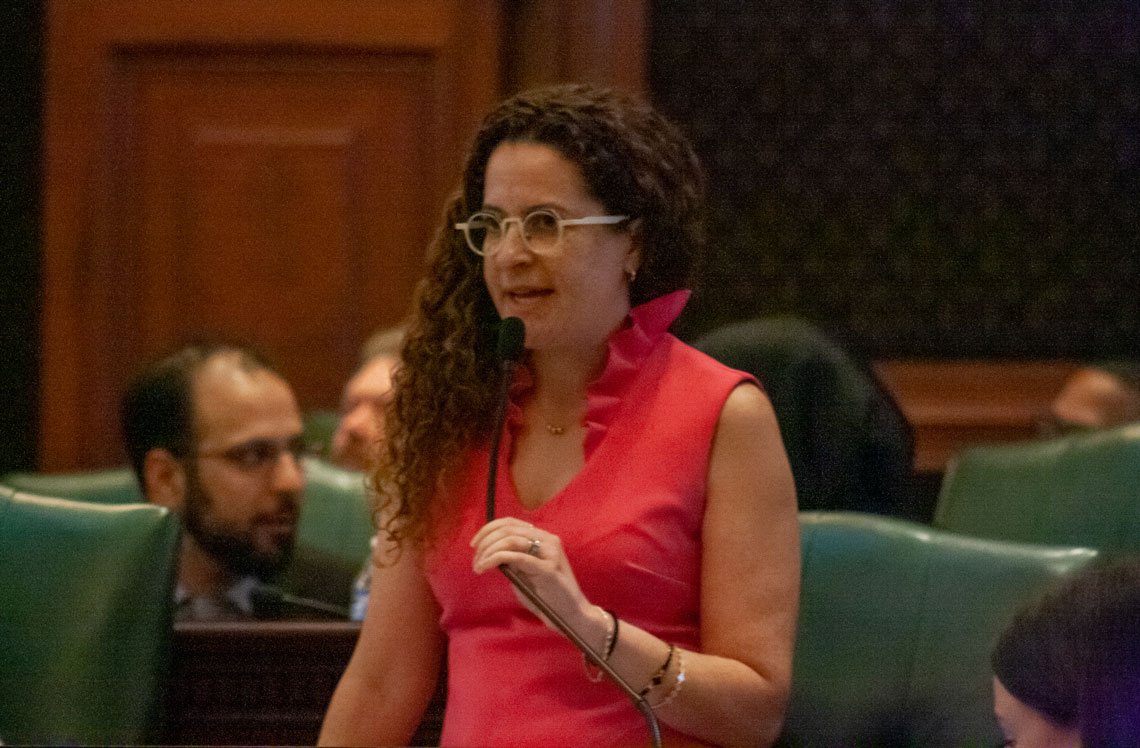

Rep. Mary Beth Canty, D-Arlington Heights speaks on the House floor April 17. Canty is the sponsor on a contentious human composting bill. (Capitol News Illinois photo by Jenna Schweikert)
House approves new privacy rules for abortion care
By JENNA SCHWEIKERT, NIKOEL HYTREK,
BEN SZALINSKI, BRENDEN MOORE,
& PETER HANCOCK
Capitol News Illinois
news@capitolnewsillinois.com
Article Summary
- The Illinois House and Senate approved hundreds of bills this week ahead of a Friday deadline, including a plan proposed by Gov. JB Pritzker to limit cell phones in schools.
- A bill allowing composting human remains advanced after years of debate on the subject.
- Lawmakers in both chambers passed different versions of a bill allowing the state treasurer to manage investments for nonprofits after Pritzker vetoed a similar bill last year.
- The House also passed bills to increase privacy for abortion records, expand bereavement leave, and allow drivers with a suspended license to use a speed control device in their car.
This summary was written by the reporters and editors who worked on this story.
SPRINGFIELD — The Illinois House on Thursday approved the latest version of a bill that would require school boards to prohibit public school students from using their cellphones in the classroom.
Senate Bill 2427, sponsored by Rep. Michelle Mussman, D-Schaumburg, passed 102-3, with one present vote. It would require Illinois school districts to adopt policies by the 2027-28 school year banning the use of wireless communication devices like cellphones, tablets, laptops and gaming devices during school time.
“The research is clear: This constant source of distraction is lowering their academic progress, increasing anxiety, depression and cyber bullying, and inhibiting face-to-face communication at a critical time when youth are developing their social skills,” Mussman said.
An earlier version passed the Senate last year, but the process “was slowed down to allow more time for thoughtful discussion,” Mussman said, which resulted in “a stronger bill.”
Under the new language, the prohibition would be bell-to-bell for elementary and middle school students, but the legislation leaves discretion for school districts to allow high school students to use their devices during lunch and breaks.
The bill also includes carveouts for students with medical needs, who are caregivers for family members, and who need their phone for English translation services. School officials can also permit device use if it’s for educational purposes.
Because the House amended the bill, it will need another vote in the Senate. Gov. JB Pritzker has been pushing for such a ban for two years.
Human composting
Lawmakers are taking another stab at passing legislation to allow human composting as a burial option.
House Bill 5425 would establish a lengthy series of regulations for composting human bodies that cemeteries, crematories and other funeral service providers must follow.
“This is a process that can help to alleviates some of the environmental concerns as it is net carbon neutral using one-eighth the energy of cremation and no harsh chemicals like things that we do in embalming,” Rep. Mary Beth Canty, D-Arlington Heights, said.
The bill has struggled to move forward in Springfield despite years of debate on the issue. But despite new changes to the proposal this year, the bill is still opposed by the Catholic Church, Cemetery and Funeral Home Association and comptroller’s office — which enforces cemetery regulations in Illinois.
The latest amendment to the bill shifted sole responsibility for regulations to the comptroller rather than the Department of Public Health.
“It’s not the same as overseeing a cemetery or a columbarium or anything of that sort,” said Rep. C.D. Davidsmeyer, R-Murrayville, adding it “relies solely on good behavior … without oversight.”
The bill passed the House on a 64-36 vote and goes for another try in the Senate.
Nonprofit investment fund
The House and Senate both passed versions of a bill to authorize the state treasurer to set up and operate an investment fund that would manage the deposits of nonprofit corporations.
The idea is an initiative of State Treasurer Michael Frerichs, who has said the fund would offer higher rates of return than banks offer through standard checking or savings accounts and greater liquidity than long-term investment funds.
Lawmakers passed similar legislation in 2025, but Pritzker vetoed it, saying such a fund could be used to benefit extremist groups that organize as nonprofit corporations.
The two bills moving through the General Assembly this year — House Bill 5045 and Senate Bill 2968 — contain language that excludes organizations that are barred from receiving state or federal contracts or grants. The bills also limit participation to groups organized for specific purposes such as labor organizations, legal aid services, food pantries, neighborhood development, affordable housing or education.
Even with those changes, the bills drew opposition from the banking industry, which views the program as a form of government competition with private business. But supporters of the bill argued it would fill a need that the banking industry is not currently meeting.
“Some of these banks will not even provide loans, let alone investment opportunities, to these small entities because they just don’t have enough money for them to where it would make sense,” Rita Mayfield, D-Gurnee, the bill’s chief House sponsor, said during floor debate.
The House bill passed 69-32, with one member voting “present.” The Senate version passed 41-16.
Each bill now goes to the other chamber for consideration.
Abortion medical records
The House on Thursday passed House Bill 5295 that would create the Reproductive Health Records Privacy Act and automatically segregate abortion-related services and treatment from digital medical records. Access to those records would be restricted for out-of-state entities. The bill is an initiative from the governor’s office.
“Here in Illinois we believe that people should be safe to receive the care that they choose to receive and therefore we want to help keep that information concealed and only released with their consent to providers outside of the state,” Canty, the bill’s sponsor, said.
She acknowledged that abortion care is criminalized or stigmatized in other states, and that patients might be treated differently if providers know about those prior diagnoses or treatments.
The information is not deleted or expunged, only restricted, and the bill gives patients the freedom to reveal any information they wish.
Republicans objected to the bill and questioned whether abortion-related information would be necessary for future treatment.
Canty said doctors from other states that have similar legislation assured her that specific information about abortion-related care is not needed.
The bill also applies to diagnoses and treatment of gender dysphoria.
The measure passed 73-34 along party lines.
Bereavement leave
A bill from Rep. Maurice West, D-Rockford, seeks to extend the type and length of bereavement leave for all employees.
House Bill 5208 would give employees at businesses with less than 50 employees the right to up to five days of unpaid bereavement leave within 12 months of the death of an immediate family member or a pregnancy or adoption-related event. Individuals who work for employers of more than 50 people are entitled to take up to 10 days.
The bill also removes a provision requiring employees to provide documentation of the loss, although employers may still ask for it. It also adds a provision for leave after the loss of a child — in that event, employers of less than 50 people are to give up to three work weeks; 50 to 250 employees up to six weeks; and more than 250 up to 12 weeks.
Finally, the bill would allow all employees up to three days of unpaid leave to make arrangements for or to attend the funeral of any person.
The bill faced scrutiny from business organizations like the National Federation of Independent Business and the Illinois Chamber of Commerce, who were concerned about the fiscal impact, particularly to small businesses.
It passed 80-26 along party lines and will now head to the Senate.
Speed control devices
Illinois lawmakers are considering giving drivers who have their license suspended for speeding an alternative by requiring them to use a speed control device.
“Speeding is a factor in nearly half of all deadly crashes and the risk of fatality increases as speed increases,” bill sponsor Rep. Marti Deuter, D-Elmhurst, said. “And we know that the primary penalty for extreme or repeat speeders, which is license suspension or revocation, doesn’t work.”
Under House Bill 4948, drivers who have their license suspended following two infractions within 12 months for speeding 26 mph or more over the speed limit would qualify to apply for a permit with the secretary of state’s office to join the program. If approved, they’d have to pay a $30 monthly fee to have the device installed in their car, which would prevent a driver’s vehicle from surpassing the speed limit. Drivers would be required to use the device for six months after their first suspension, one year after their second suspension and two years after three or more suspensions.
The bill caused some consternation for some lawmakers who worried about disproportionate impacts on people of color.
“I have serious concerns,” said Rep. Curtis Tarver, D-Chicago. “I think we all know from an anecdotal perspective that it’s mostly Black and brown individuals who are stopped by law enforcement. So by default, I think we’re often most likely to be the individuals who are caught up with what your bill is … aiming to enforce.”
Tarver ultimately voted for the bill, which passed the House 77-24, with one lawmaker voting present. It now goes to the Senate.
Assault investigations
House Bill 4394 would require law enforcement agencies with officers of more than one sex or gender to inform victims of sexual assault or abuse that they can request that their interview is given by an officer of a specific sex or gender, when one is available. This includes law enforcement offices, hospitals or other health care facilities.
If the requested officer is not available, the victim may consent to be interviewed by someone else, reschedule the interview or cancel it. The bill, sponsored by Rep. Daniel Didech, D-Buffalo Grove, passed unanimously and now heads to the Senate.
Capitol News Illinois is a nonprofit, nonpartisan news service that distributes state government coverage to hundreds of news outlets statewide. It is funded primarily by the Illinois Press Foundation and the Robert R. McCormick Foundation.


